How to Find Viral Reels in Your Niche (Before They Peak)
Instagram has no way to search Reels by performance. The method that works is building a list of accounts, ranking each one, and looking for the format that shows up on more than one list.
You can't search Instagram for viral Reels. There's no performance filter, no sort by views on any search result, and the Explore page shows you what it thinks you personally will watch, which is a different question from what's working in your niche.
The method that does work runs in the opposite direction. Build a list of accounts, rank each one by outlier score, and look for the format that appears on more than one account's list. A topic that pushed past 2x for two different audiences is a topic that travels, and that's the closest thing to a reliable signal Instagram will give you.
Most guides tell you to browse hashtags. Hashtag results are ordered by Instagram's relevance model with no view counts attached, so you end up guessing at performance from likes. That's the wrong end of the problem.
Why can't you search Instagram for viral reels?
Instagram publishes view counts on individual Reels and refuses to let you sort or filter by them anywhere. Search returns accounts, audio and keyword matches. Explore is personalized to your own watch history. Hashtag pages show recent and top posts by Instagram's own definition of top, which is not view count and is not disclosed.
There's no date filter either, so you can't ask for "Reels in this niche from the last two weeks" the way you'd query any normal database.
What Instagram does expose is per-account data. Every public profile's Reels tab shows a view count on every thumbnail. So the unit of research on Instagram is the account, not the search query, and everything below is a way of turning a list of accounts into a list of ideas.
Step 1: build the account list
Start with 10 to 15 accounts across four layers. Most people only do the first one, which is why most people's research produces the same content everyone else is making.
Direct competitors. The accounts your audience already follows alongside yours. Useful for knowing what you're up against, and the weakest layer for ideas, since they're guessing too.
Adjacent niches. One step sideways. If you're in home fitness, that's physiotherapy, meal prep, and running. Formats cross these borders easily and audiences overlap enough that a proven idea usually survives the trip.
Format leaders outside your world entirely. Accounts you'd never compete with, picked because they're unusually good at one structure. A finance creator who has perfected the two-second cold open has something to teach a gardening account. Bringing those formats across on purpose is the outlier transfer method.
Small accounts that are punching above their size. The most valuable layer and the one nobody builds. More on finding them in how to find small Instagram accounts getting huge views.
Keep the list in a sheet with a column for which layer each account belongs to. You'll want to know later whether an idea came from your own niche or arrived from somewhere else.
Step 2: rank each account and export only the outliers
For each account on the list, open its Reels tab and rank it. By hand this means recording view counts into a spreadsheet and dividing each by the median, which takes about an hour per account. With the free ViewRank extension it's a few seconds:
- Open
instagram.com/username/reels. - Click the ViewRank icon, keep the mode on Videos, and pick a scan depth. 100 to 200 is enough for the baseline on an account you don't know.
- Press Rank Now, then click the Outliers tab.
- In the Export row, set the scope to Only Outliers and the format to For Sheets, then press Copy.
Paste into your sheet. Repeat for each account. Fifteen accounts takes about twenty minutes, and you end up with one table containing every Reel in your niche that beat its own creator's normal by 2x or more.
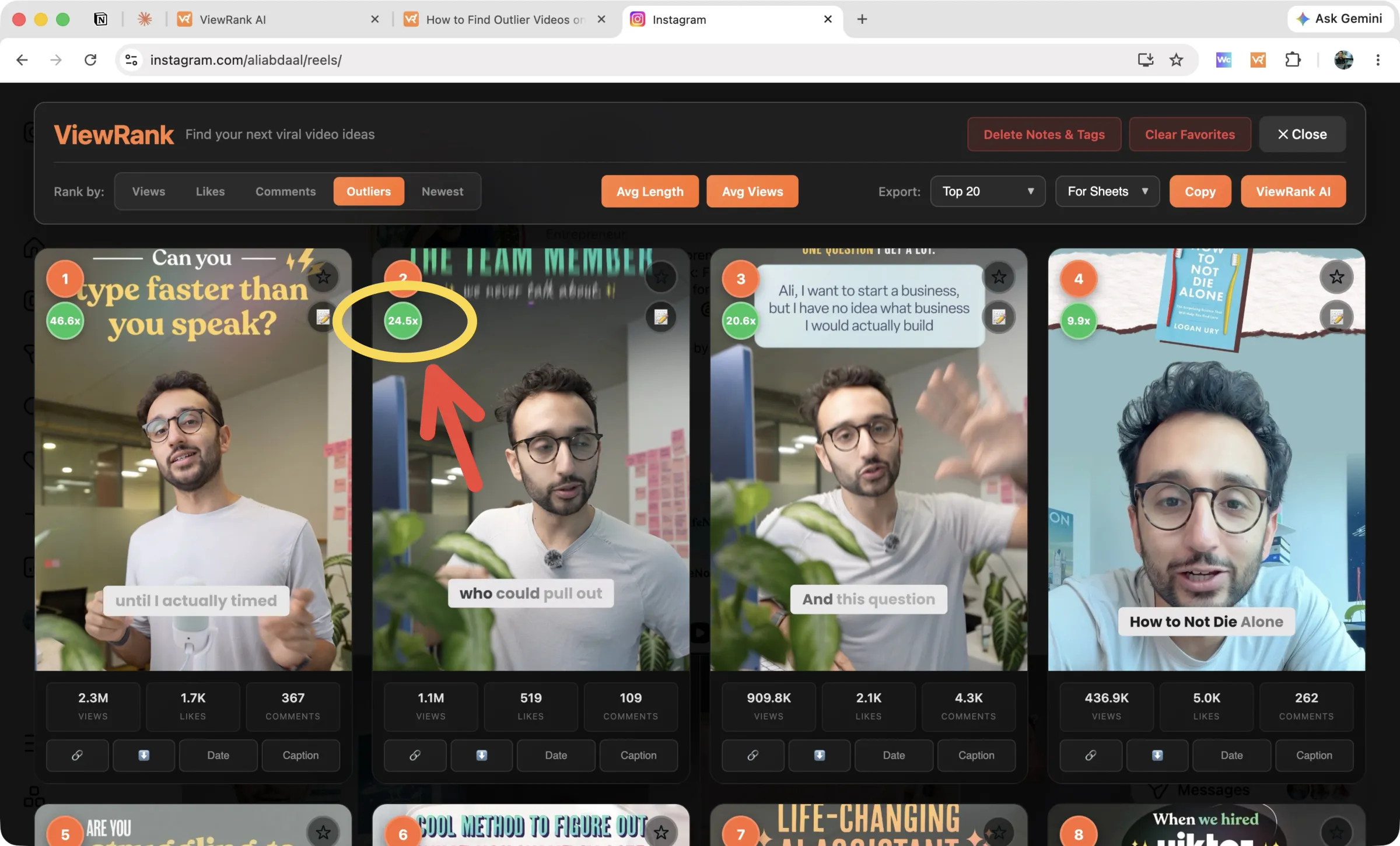
The scoring compares each Reel against other Reels from the same period of that account rather than against the platform, which is what makes a small creator's 8x Reel show up next to a large creator's 8x Reel as an equal. Details in how to find outlier videos on Instagram. The TikTok version of this whole routine is how to find trending TikTok videos in your niche.
Sort any Instagram or TikTok profile in one click
The free ViewRank Chrome extension ranks any profile's videos by views, likes, comments, or outlier score, right on the page.
Add ViewRank to Chrome, it's freeStep 3: find the format that appears on more than one list
Sort your combined table by outlier score and read the top 30 with one question in mind. What structure is this, described without its topic?
Write the structure down in your own words. "Creator disagrees with a common piece of advice, then explains why." "Silent process shot with text captions counting the steps." "Question in the first second, answer withheld until the end." Strip the subject matter out entirely.
Then count. A structure appearing once is that creator's habit. The same structure on four accounts, especially across two different layers of your list, is a pattern in the niche, and patterns are the only thing here worth building a month of content on.
This is the step people skip, and skipping it is how you end up remaking one specific video instead of learning what your audience responds to.
Step 4: check the dates before you commit
An outlier from three months ago tells you what worked under a version of the recommendation system that may no longer exist. One from the last three weeks tells you what's working now.
Add a date column to the sheet. In the ViewRank overlay, each card has a Date button that fetches when the Reel was posted, so you can fill the column in for the Reels you're keeping. How to see when an Instagram Reel was posted covers the exact date and time too. Filter your combined table to the last 30 days and re-read the top of it. The list gets much shorter and much more useful.
There's a tension worth naming here. Recent outliers are more relevant and less proven, since a Reel posted last Tuesday hasn't finished collecting views. Anything under 48 hours old should be treated as a guess rather than a result.
How do you find viral reels before they peak?
Watch small and mid-size accounts rather than large ones, and check them often rather than deeply.
A format usually appears on a small account first, because small creators experiment more and have less to lose. By the time it reaches an account with two million followers, it's been copied for weeks and your version arrives late. The 15,000-view Reel from a creator who averages 1,200 is a much earlier signal than the two-million-view Reel from someone who averages a million.
Checking often is the harder half, since it means reranking fifteen accounts every week and remembering to do it. The Viral Tracker in ViewRank AI runs that loop for you. Add the accounts once, and new Reels crossing 2x their creator's average land in an Videos that went viral feed with the score attached and a "New" pill. Anything under 48 hours old is held back until the numbers settle.
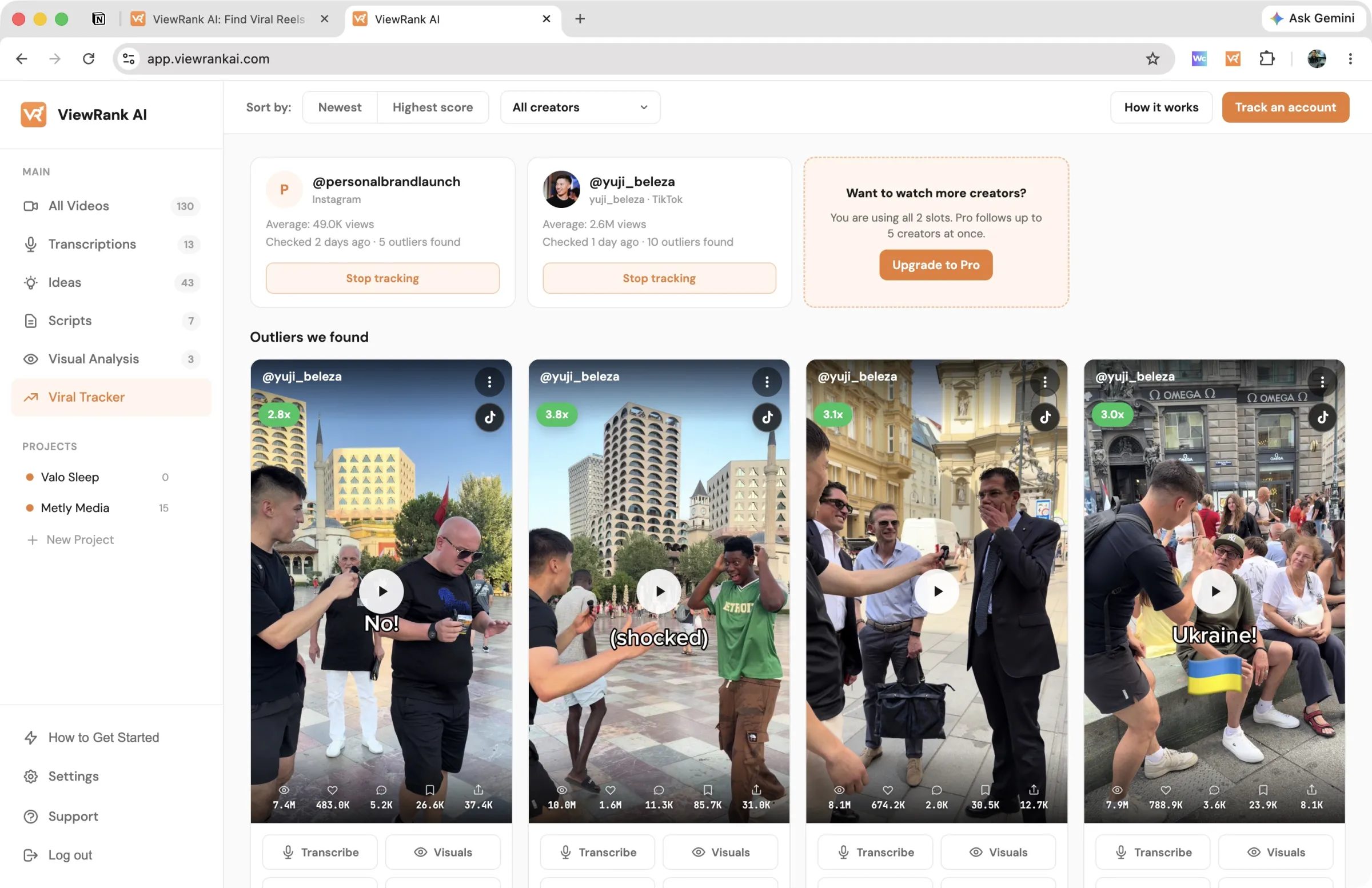
Each card in that feed carries Transcribe, Visuals and Scripts buttons, so a Reel can go from detection to a draft without you opening Instagram. Setup is on the tracked accounts page, and how to track Instagram and TikTok creators covers the routine in full.
Does the Explore page help at all?
A little, and not for the reason people think. Explore won't tell you what's viral in your niche, because it's built around your personal watch history rather than any niche's performance data.
Where it earns its place is discovery of accounts you didn't know about. Watch and interact with content in your target niche from a browser profile you use only for research, and Explore will start surfacing creators in that space, including small ones. Those accounts go on your list from step 1, and then you measure them properly.
Treat Explore as a source of names, not a source of conclusions.
How do you turn a viral reel into your own video?
Pull the transcript first. The opening line carries more of the result than anything else in the video, and reading it as text removes the delivery so you can judge the words on their own. Our free Instagram reel transcript generator returns the spoken lines from any public Reel without an account.
Rebuild the structure with your own topic, not the topic with your own face. A copy competes directly with the original and loses, because the original has the head start and usually the bigger audience. The same skeleton carrying information only you have is a different video. How to write a Reel script from a competitor's transcript is the step-by-step version, and breaking the Reel down scene by scene covers the visual layer a transcript misses.
Read the comments before you write anything. An outlier's comment section fills with questions, and every question is a follow-up video with demonstrated demand already attached to it.
Want to know why those videos worked?
ViewRank AI transcribes winning videos, breaks down their visuals scene by scene, and turns the patterns into fresh ideas and scripts for your own niche. Free for 7 days. Cancel anytime.
Start your free trialFAQ
How do you find viral Reels in your niche?
Build a list of 10 to 15 accounts in and around your niche, rank each profile by outlier score, and export the Reels that beat their creator's own average by 2x or more. Then look for the format that appears across several accounts. Instagram provides no way to search or sort Reels by performance, so research has to run account by account.
Can you search Instagram for the most viewed Reels on a topic?
No. Instagram search returns accounts, audio and keyword matches with no performance sorting, and hashtag pages order results by Instagram's undisclosed definition of top rather than by views. View counts are only visible on individual Reels inside a profile.
How many accounts should you track for niche research?
10 to 15 is enough to see patterns without becoming unmanageable. Spread them across direct competitors, adjacent niches, accounts that are strong on one format, and small accounts that overperform their size.
How recent does a viral Reel need to be to be useful?
Prefer the last 30 days, and treat anything under 48 hours old as unfinished, since the view count is still moving. A Reel from three months ago describes a version of the recommendation system that may have changed.
Is it better to copy a viral Reel or adapt it?
Adapt the structure and replace the content. A direct copy competes with the original, which already has the audience and the head start. The portable parts are the hook shape, the pacing and the format, not the words or the clips.
Do hashtags help find viral Reels?
Barely. Hashtag pages show recent and top posts by Instagram's own ranking, which is not view count and is not published, so you'd be inferring performance from likes. They're useful for finding accounts to add to your list, and unreliable for judging what performed.