How to Find Small Instagram Accounts Getting Huge Views
A 40,000-view Reel from an account with 900 followers is a better research find than a two-million-view Reel from a major creator. Here is how to find those accounts and why they are the earliest signal available.
A small account with a Reel far above its own normal is the earliest signal available on Instagram. When someone with 900 followers posts a Reel that does 40,000 views, nothing about their audience explains it. The recommendation system carried that video to strangers on the strength of the video alone, which is exactly the information you want and almost never get from a large account.
Large creators are the opposite. A two-million-view Reel from someone with three million followers might be a good video, or it might be a mediocre video that a large audience saw anyway. You can't separate the two, so the finding is unusable.
Nobody is copying the small accounts yet, which is the practical argument. By the time a format reaches an account big enough for you to notice by accident, it has been running for weeks.
Why do small accounts give better research signal?
Because on a small account, reach cannot be explained by the audience.
Instagram distributes Reels well beyond followers, so every Reel gets some exposure to strangers. On a large account that muddies the measurement, because the follower audience alone can produce a respectable view count. On an account with 900 followers, 40,000 views means roughly 39,000 strangers were served the video and stayed long enough to count. The video did that.
There's a second reason, which is behavioral rather than mathematical. Small creators experiment more. They have no format that's working to protect, no audience expectation to manage, and no downside to a video that flops. So new structures appear on small accounts first and migrate upward. Watching only large accounts means watching the end of that process.
The trade-off is noise. Small accounts have fewer videos, so their baselines are less stable, and a 15x score built on 20 videos is a weaker claim than a 15x score built on 200. Treat small-account outliers as leads worth checking rather than as proven results.
Where do you find small accounts in your niche?
Instagram won't let you filter by follower count, so the accounts have to come from somewhere else. Four sources that actually produce names:
The comment sections of outliers you already found. When a Reel overperforms, other creators in the niche show up in the comments. Their handles are right there, and the ones leaving substantive replies are usually active posters rather than lurkers.
Tagged and collab posts on mid-size accounts. Larger creators collaborate with smaller ones constantly. Open a mid-size account's tagged tab and you get a list of people working in the same space at a smaller scale.
A research-only browsing profile. Use a separate browser profile, watch and interact only with content in your target niche, and let Explore adapt. Within a week it starts surfacing smaller creators in that space. The accounts it shows you are candidates, not conclusions, and they go on the list to be measured.
Reels using a sound you know performed. Open the audio page from any Reel and it lists other Reels using the same sound. Sounds attract creators working the same format, and the list mixes sizes freely.
Collect 15 to 25 handles. The hit rate here is lower than with established competitors, so the list needs to be longer.
How do you tell if a small account is actually overperforming?
Rank the profile and read the multiplier, not the view count. This is the whole method, and doing it by eye is where people go wrong.
Your eye anchors on absolute numbers, and absolute numbers on a small account are small. A 45,000-view Reel looks unremarkable next to a 900,000-view Reel from a large creator, right up until you notice the first one is 15x its account's normal and the second is 0.9x.
With the free ViewRank extension:
- Open the profile's Reels tab at
instagram.com/username/reels. - Click the ViewRank icon, keep the mode on Videos, and pick a scan depth. On a small account, choose All rather than 100, since there may only be 60 Reels in total and the baseline needs everything it can get.
- Press Rank Now, then click Outliers.
- Press Avg Views in the overlay header. It prints the account's average, median, minimum and maximum across their recent 30 Reels.
That last step matters more on small accounts than anywhere else. If the average sits far above the median, one breakout is inside the window and the account is less consistent than it looks. If they're close, the account has a real baseline and any outlier above it is a genuine finding.
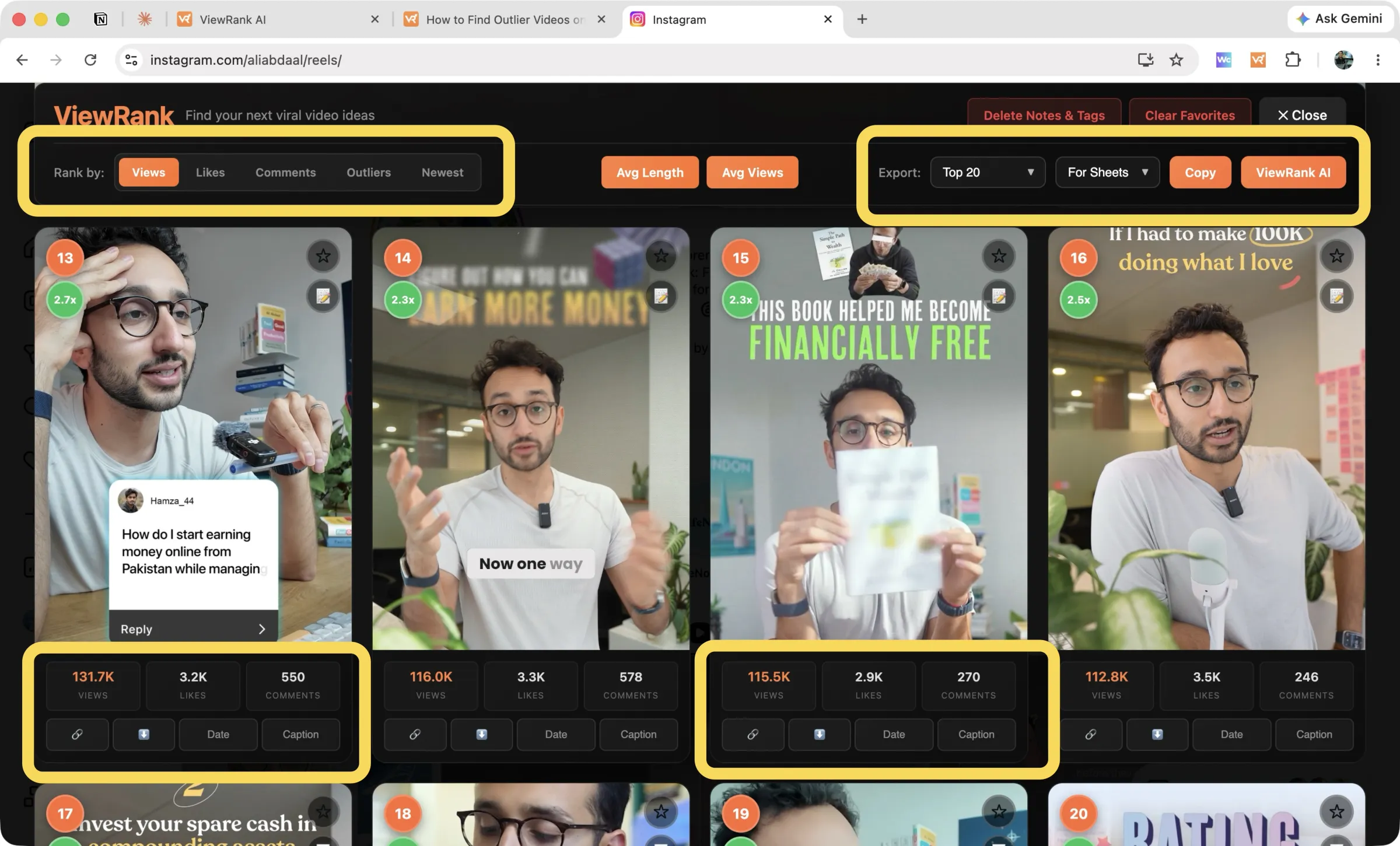
The scoring compares each Reel against others from the same period of the account, dropping the top and bottom of each batch before setting the baseline, which is what stops one lucky video from defining an entire small account. The method is explained in how to find outlier videos on Instagram.
Sort any Instagram or TikTok profile in one click
The free ViewRank Chrome extension ranks any profile's videos by views, likes, comments, or outlier score, right on the page.
Add ViewRank to Chrome, it's freeWhat counts as small, and how small is too small?
Under about 50,000 followers is where the signal gets clean, and under 5,000 is where it gets noisy for a different reason. Typical Reel views at each size are in how many views is viral on TikTok and Instagram Reels.
Between roughly 5,000 and 50,000 followers is the useful band. There are enough Reels to build a baseline, the creator is usually posting consistently, and the follower audience is still too small to explain a big view count on its own.
Below 1,000 followers, two problems arrive together. The account may have fewer than 30 Reels, which makes any baseline shaky, and a single video reaching 40,000 views may genuinely be luck rather than a repeatable format. Look at those, and confirm the format somewhere else before you build on it.
The number that matters more than follower count is Reel count. An account with 900 followers and 200 Reels is a better research subject than one with 20,000 followers and 12 Reels, because only the first one has enough history to say what normal looks like.
Confirming a small-account find before you build on it
One small account with a 15x Reel is a lead. Confirming it takes one more step, and skipping that step is how people spend a week rebuilding a fluke.
Describe the structure without its topic, then go looking for it. Search the phrase from the hook. Check the sound page if it used a distinctive audio track. Look at the other accounts on your list and see whether anything with the same shape has appeared there in the last month.
If the structure shows up on two or three other accounts, especially at different sizes, you've found a format. If it appears nowhere else and the creator hasn't repeated it themselves, you've found one video that got lucky, and the honest move is to note it and move on.
A useful tell: check whether the creator tried the format again. Creators notice their own outliers, and a format that worked usually reappears on their profile within a few weeks. If they tried it twice and it worked twice, that's worth more than any single multiplier.
How do you keep watch on small accounts without checking them by hand?
The problem with small-account research is frequency. These accounts post irregularly, their outliers arrive without warning, and reranking 25 profiles every week is not a habit anyone keeps.
The Viral Tracker in ViewRank AI watches them instead. Add a creator by handle or profile link, and it measures their baseline and re-checks every few days, surfacing new Reels that cross 2x their average in an Videos that went viral feed with the score attached. Reels under 48 hours old are held back until the numbers settle, which matters more on small accounts where early counts move fast.
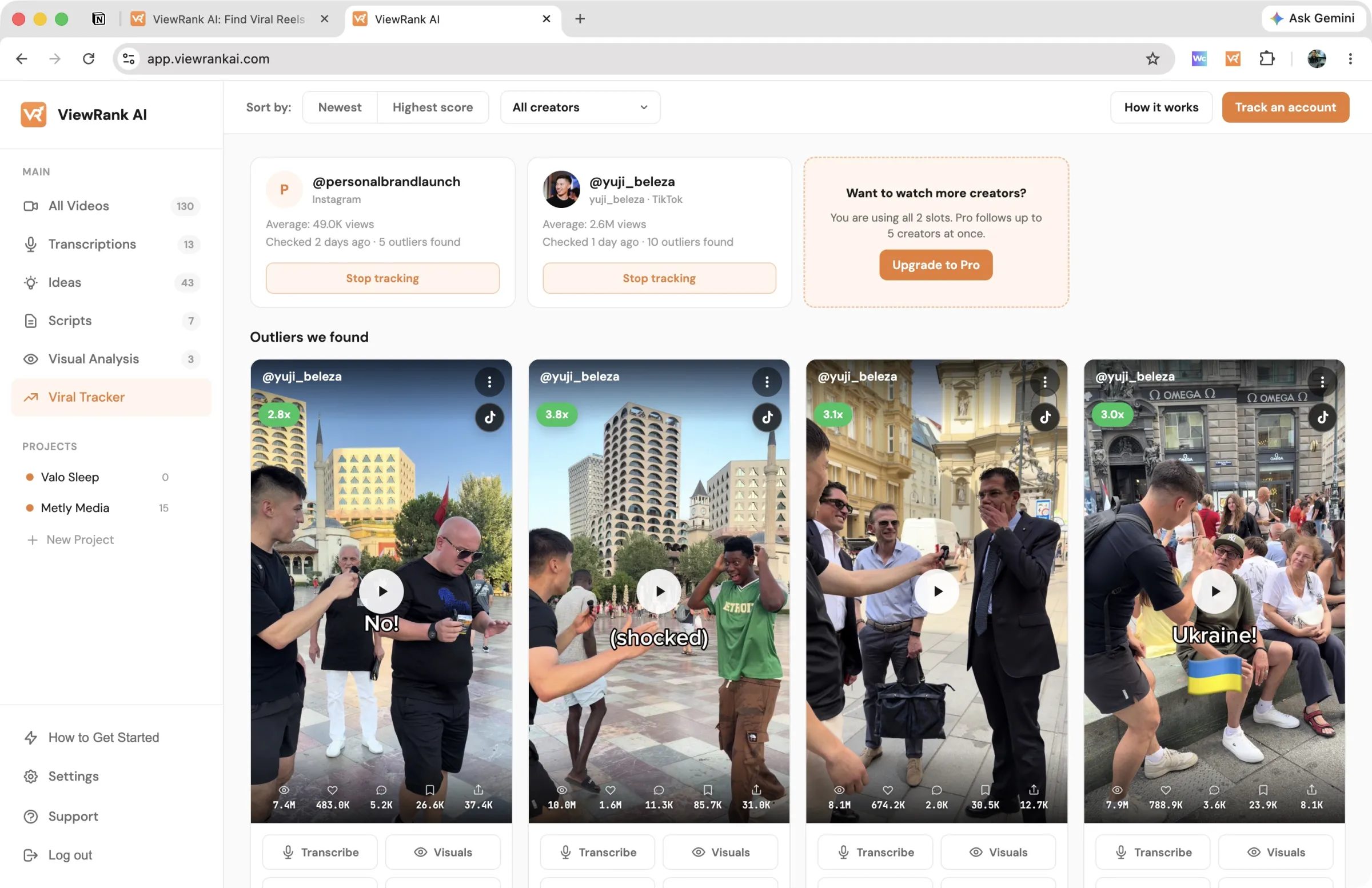
Each card carries Transcribe, Visuals and Scripts buttons. Setup is on the tracked accounts page, the full tracking routine is in how to track Instagram and TikTok creators, and the broader research routine is in how to find viral Reels in your niche.
Want to know why those videos worked?
ViewRank AI transcribes winning videos, breaks down their visuals scene by scene, and turns the patterns into fresh ideas and scripts for your own niche. Free for 7 days. Cancel anytime.
Start your free trialFAQ
Why are small accounts better for content research than big ones?
On a small account, a large view count can't be explained by the follower audience, so the reach came from the recommendation system responding to the video itself. On a large account, a big number might just mean a big audience saw it. Small creators also experiment more, so new formats appear there first.
How do you find small Instagram accounts in a niche?
Read the comment sections of outlier Reels you've already found, check the tagged tab on mid-size accounts for collaborations, use a research-only browsing profile so Explore adapts to the niche, and open the audio page of any Reel that performed to see who else used the same sound.
What follower count counts as a small account?
Roughly 5,000 to 50,000 followers is the most useful band for research. Below 1,000 followers the signal gets noisy, because those accounts often have too few Reels to build a reliable baseline from.
How can you tell if a small account's Reel actually overperformed?
Compare it to that account's own median views rather than to any absolute number. A 45,000-view Reel on an account that normally does 3,000 is a 15x outlier. The same 45,000 views on an account that normally does 60,000 is a below-average video.
Is one outlier from a small account enough to act on?
No. Treat it as a lead. Confirm the format appears on other accounts, or that the creator repeated it themselves and it worked twice, before you build content around it. Small accounts have shaky baselines and single videos do get lucky.
How many Reels does an account need for its baseline to be reliable?
At least 50, and more is better. Reel count matters more than follower count here. An account with 900 followers and 200 Reels gives you a far more trustworthy baseline than one with 20,000 followers and a dozen Reels.