The Outlier Transfer Method: Remaking Viral Videos From Other Niches
The best content ideas for your niche already went viral somewhere else. Here is a repeatable method for finding a proven video in an unrelated niche and rebuilding it for your audience.
The strongest content idea available to you this week already went viral in a niche that has nothing to do with yours. Nobody in your space has seen it, the format is proven, and the audience it worked on is more similar to yours than either of you would admit.
Studying only your direct competitors means competing on execution of ideas everyone already has. Your competitors are guessing too. Meanwhile a format that has been working in personal finance for two months has never been tried in home renovation, and the first person to bring it across gets the whole advantage.
Call it the outlier transfer method. The name matters less than the five steps: pick your source niches, find the outliers inside them, strip each one to its mechanism, test whether that mechanism survives the move, then rebuild it with your own topic.
Why do formats transfer between niches?
Because a format works on a human response, and the response is the same regardless of subject.
A video that opens by naming a mistake the viewer is probably making works because being told you're doing something wrong is uncomfortable enough to hold you. That's true whether the mistake is in your deadlift, your sourdough, your tax return or your lighting setup. The discomfort is the mechanism. The topic is the costume.
The same goes for a before-and-after reveal, a myth corrected, a process compressed into ten seconds, an expensive mistake priced in real money, or a thing everyone does that turns out to be backwards. None of these belong to a niche.
What doesn't transfer is anything resting on the audience already knowing something. Insider jokes, references to a specific creator, and formats built on a running series all break when they cross over.
Distance helps rather than hurts. A format taken from an adjacent niche looks derivative to your audience, because half of them follow those accounts too. A format taken from six niches away looks original.
Step 1: pick your source niches deliberately
Don't browse randomly. Choose four or five source niches and stick with them, because familiarity is what lets you spot a format that's new rather than one that's been running for months.
Two useful ways to choose. Pick niches with a similar emotional job to yours: if your content solves an anxiety, other anxiety niches transfer well, so personal finance, health admin, legal basics and parenting all trade formats readily. Or pick niches known for high production discipline, since they're where new formats get invented and refined. Finance, fitness and food are the usual three, and they're relentless about testing openings.
Write your source list down. This is the thing people skip, and it's why their "cross-niche research" lasts one afternoon.
Step 2: find the outliers, not the popular videos
This is where the method usually goes wrong. People open a big account in another niche, watch its most-viewed video, and try to rebuild it. That video is popular because the account is large, which tells you nothing.
You want videos that beat their own account's normal by a wide margin, because a large multiple means the recommendation system pushed the video to people who had never seen that creator. That's a video whose format did the work.
By hand: open a profile, record the view counts of the last 50 videos into a sheet, get the baseline with =MEDIAN(B2:B51), and divide each video by it. Anything at 2x or above is worth watching. It's about 40 minutes per account.
Faster: the free ViewRank extension ranks a profile on the page. Open instagram.com/username/reels or a TikTok profile's Videos tab, click the extension icon, press Rank Now, then click the Outliers tab. Set the export scope to Only Outliers and copy it into your sheet. The full method is in how to find outlier videos on Instagram.
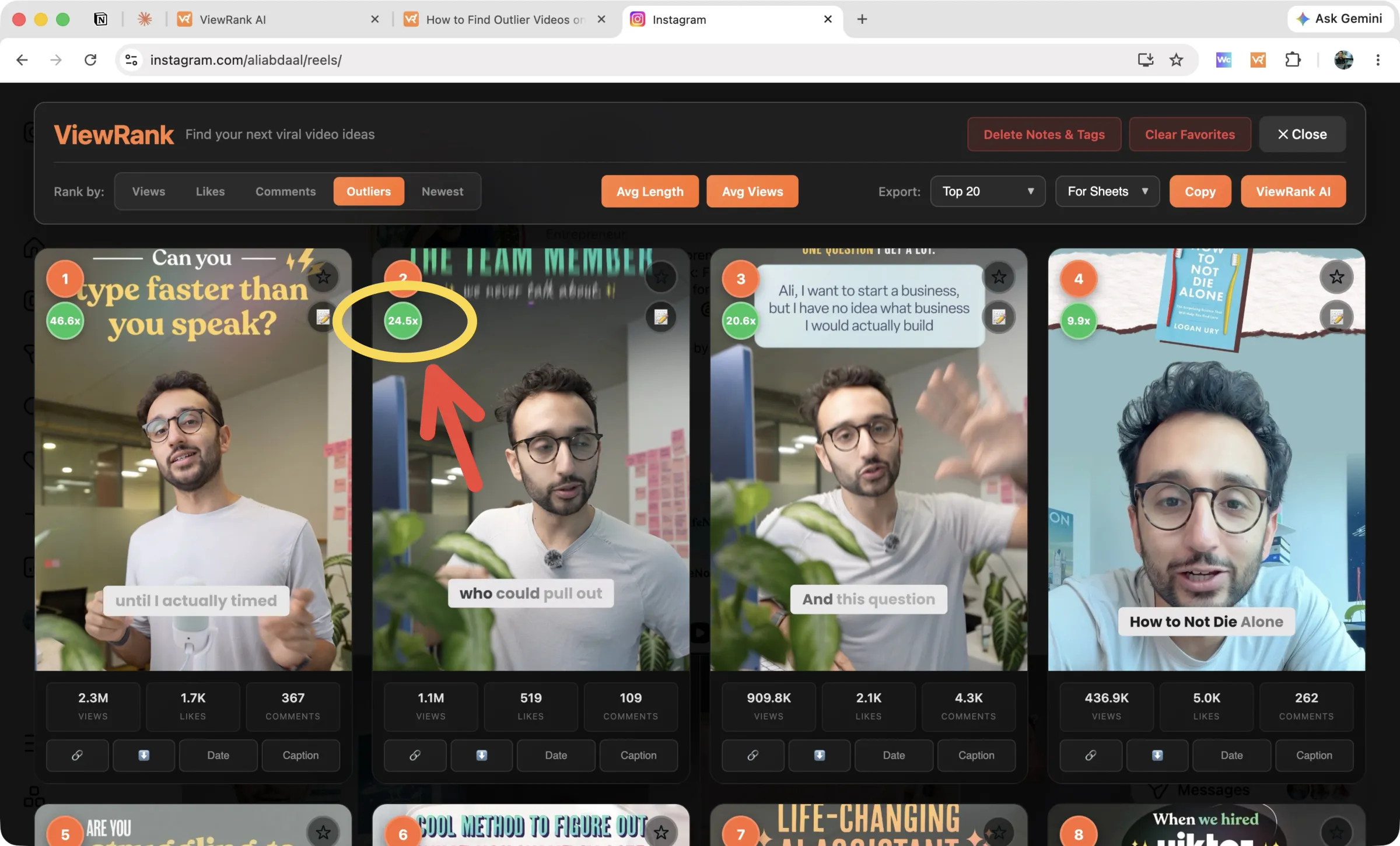
Do that for five or six accounts in each source niche and you'll have a list of a few dozen proven videos from worlds your audience has never looked at. The account-list side of this, layered by how far a niche sits from yours, is in how to find viral Reels in your niche.
Sort any Instagram or TikTok profile in one click
The free ViewRank Chrome extension ranks any profile's videos by views, likes, comments, or outlier score, right on the page.
Add ViewRank to Chrome, it's freeStep 3: strip the video to its mechanism
For each candidate, write one sentence describing why it worked, with no topic words in it at all.
Not "she showed three cheap protein sources." That's the content. The mechanism is "expert contradicts a piece of advice the audience has heard many times, then justifies the contradiction with a number in the first eight seconds."
Doing this well is the skill the whole method rests on. Some tests to force it:
Could you write the sentence about a completely different subject and have it still make sense? If not, you haven't reached the mechanism yet.
Does the sentence name a viewer response? Discomfort, curiosity, recognition, disagreement. A mechanism that doesn't name a feeling is usually still a description of the content.
Is it short? A mechanism you need three sentences to describe is probably two mechanisms, and one of them is doing most of the work.
Pulling this out by hand means watching the video several times, and the scene-by-scene breakdown method is the long version of that process.
Step 4: run the transfer test before you build
Not every mechanism survives the trip. Four questions, and a no on any of them kills the idea before it costs you a filming day.
Does your audience hold the belief being contradicted? A myth-correction video needs the myth to be widespread in your niche. If nobody believes the thing, correcting it is confusing rather than satisfying.
Can you supply the proof beat? Most transferable formats have a moment where evidence lands. If the original used a dramatic visual result and your topic produces nothing visible, you need a substitute before you commit, not during the edit.
Does the emotional register fit your account? A confrontational format works for a creator whose audience expects confrontation. Dropped onto a gentle account it reads as a personality transplant, and the comments will say so.
Is the format already in your niche? Search the hook shape and check a few competitors. If three accounts in your space ran it last month, you're not transferring, you're arriving late.
Step 5: rebuild, and change one thing on purpose
Fill the mechanism with your own topic, then deliberately change one structural element. Make it shorter, or move the payoff earlier, or swap the talking head for a process shot. Writing the script from the source video's transcript is the detailed version of the fill step.
Two reasons. A perfectly faithful port often reads as a format the audience can't place, and a small change makes it yours. And varying one element per attempt is the only way you'll learn which part of the mechanism was load-bearing, because you get a data point rather than a result.
Keep a record. Source niche, mechanism sentence, what you changed, and how the video did against your own baseline. After ten attempts, the record tells you which source niches transfer to your audience and which don't, and that's worth more than any individual video.
How often does a transfer actually work?
Less often than the method's advocates suggest, and often enough to be the best use of research time available.
Be prepared for most transfers to land as ordinary videos. The wins are large when they come, because a format that's new to your niche has no competition for attention in it, but a run of flat results is normal rather than evidence the method is broken.
The transfers that fail usually fail at step 4 and the creator skipped it. The second most common failure is transferring the content instead of the mechanism, which produces a video about someone else's topic on your account.
How do you keep finding transferable outliers?
The method has one practical problem. Outliers in your source niches appear without warning, and checking six accounts across five niches every week is not a routine anyone sustains past a month.
The Viral Tracker in ViewRank AI watches them for you. Add creators from your source niches by handle or profile link, on Instagram or TikTok, and it works out each account's baseline from around 50 recent videos, drops the top and bottom 20% and averages the middle, then re-checks roughly every three days. Anything that reaches 2x that average lands in an Videos that went viral feed with the multiple attached.
Videos under 48 hours old aren't judged, since a video needs a few days to find its audience. Pinned videos are ignored. When a video is still climbing between checks, the card says so and shows what it was flagged at, which is useful here because a format that's still accelerating in its source niche is one you want to move on quickly.
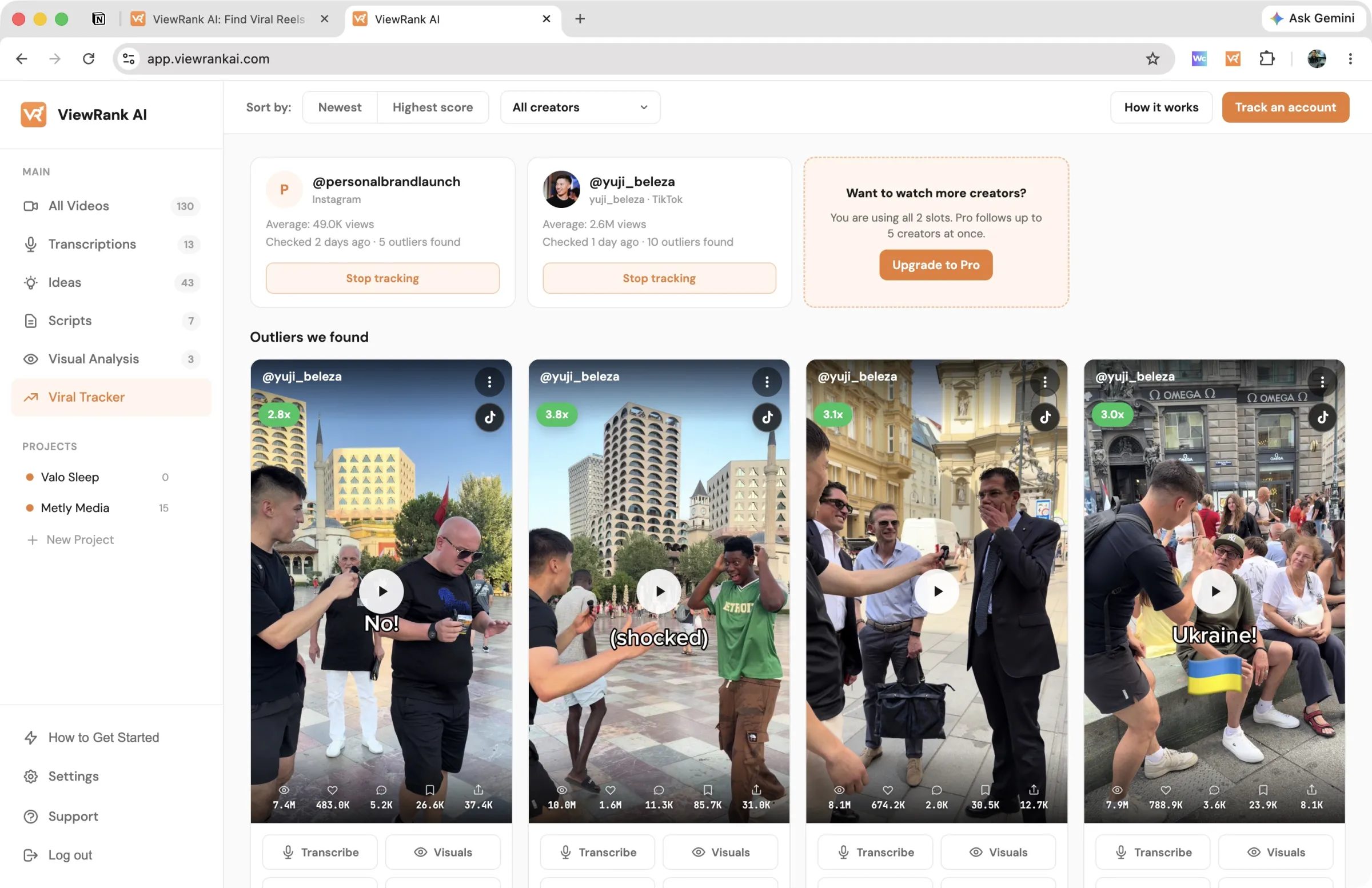
Each outlier card carries Transcribe, Visuals and Scripts. Visual Analysis returns the scene-by-scene breakdown that step 3 needs, with a still frame on every scene, and the Ideas step is built around exactly this method: every run gives you one faithful remake with your topic swapped in, plus three ideas that take the transferable part and apply it to different subjects. Setup is on the tracked accounts page, and how to track Instagram and TikTok creators covers the routine it replaces.
Want to know why those videos worked?
ViewRank AI transcribes winning videos, breaks down their visuals scene by scene, and turns the patterns into fresh ideas and scripts for your own niche. Free for 7 days. Cancel anytime.
Start your free trialFAQ
What is the outlier transfer method?
Finding a video that massively outperformed its own account in a niche unrelated to yours, reducing it to the mechanism that made it work, checking that the mechanism survives the move to your audience, and rebuilding it with your own topic. It works because formats operate on human responses rather than on subject matter.
Why look at other niches instead of your competitors?
Your direct competitors are working from the same ideas you are, so competing there means competing on execution. A format proven in a distant niche is new to your audience, and being first to bring it across is a larger advantage than executing a familiar idea slightly better.
Which niches transfer well?
Niches with a similar emotional job to yours, and niches known for testing formats aggressively. Personal finance, fitness and food invent and refine short-form formats faster than most, and their structures move readily into other topics. Adjacent niches transfer least usefully, because your audience already follows those accounts.
What kinds of video formats don't transfer between niches?
Anything relying on the viewer already knowing something. Running series, insider jokes, references to a specific creator, and formats built on a shared history with the audience all break when they cross into a niche that doesn't have that context.
How do you find outlier videos in a niche you don't know?
Pick five or six accounts in that niche and measure each video against that account's own median views rather than against any absolute number. A video at 2x its account's baseline overperformed regardless of how large the account is. Sorting by raw views instead mostly surfaces whatever the account posted after it got popular.
How do you tell the mechanism from the content?
Write one sentence explaining why the video worked, using no words specific to its topic. If the sentence still makes sense applied to a completely different subject, and it names a viewer response such as curiosity or discomfort, you've found the mechanism. If it only makes sense for that topic, you're still describing the content.