How to Break Down a Viral Reel Scene by Scene (Hook, Retention Beats, Payoff)
Watching a viral video once tells you nothing. Here is the five-pass method for taking a Reel or TikTok apart scene by scene, so you can name what made it work and rebuild it with your own topic.
Breaking a viral video down scene by scene means watching it at least five times, each pass looking at one layer only. The layers are the hook, the scene structure, the words, the visuals with the sound off, and the moments where you nearly left. Trying to notice all of that at once is why most people watch a viral Reel, say "the editing is good," and learn nothing they can use.
You already know this works, because it's what film students do with a scene and what copywriters do with an ad. Short-form is easier, since the whole thing is under 60 seconds and every frame is available to you.
What you can't get is the creator's retention graph. Instagram and TikTok show those only to the account that posted the video, so anything you read about "the retention curve of this viral Reel" from someone who doesn't own the account is guesswork. You can infer where attention held by watching your own behavior carefully, which is what pass five is for, and that's an honest method rather than a pretend one.
What does breaking down a video scene by scene mean?
It means writing down, for every distinct shot or beat in the video, three things: what is said, what is on screen, and what job that moment does for the video as a whole.
A typical short-form video has three to six scenes. A scene changes when the shot changes, when the location or framing changes, or when the video moves to a new point. On-screen text changing is usually a scene boundary too, since the text is doing narrative work.
The output is a table. That matters more than it sounds, because a table forces you to write something in every cell, and the cell you struggle to fill is usually the thing you hadn't noticed.
Set up so you can actually study the video
Watching in the app is the wrong environment. The feed autoplays the next video, there's no scrubbing precision, and you'll lose the video you were studying.
Get the file, or something close to it. Download the video, or open it in a player where the arrow keys step through frames. In QuickTime and VLC the left and right arrow keys move a frame at a time, which is what you need for the hook pass, since a two-second hook is roughly 60 frames and the decision happens in the first 10 of them.
Get the transcript separately, as text. Reading the words on a page instead of hearing them removes the creator's delivery, and delivery is the least portable part of any video. Our free Instagram reel transcript generator and TikTok transcript generator both return the spoken lines from any public video with no account needed. The step-by-step versions are how to transcribe an Instagram Reel for free and how to transcribe a TikTok for free.
Open a document with a table in it. Columns: timestamp, what's said, what's on screen, what this does.
Pass 1: the hook, frame by frame
Watch only the first two seconds, five or six times, and answer four questions in writing.
What is the first thing you hear? Write the exact words. Count them. Viral openings are usually short enough to say in one breath, and the specific noun usually arrives in the first four words.
What is the first thing you see? Not the subject, the composition. Is it a face at close range, a hand doing something, text on a plain background, motion already in progress? A video that opens mid-action is making a different bet than one that opens on a still face.
What is promised, and how specific is it? Every hook makes a contract. "I'll show you the mistake" is weak. "This is why your second reel always dies" is specific enough that a person with that problem cannot leave.
What is withheld? The answer, the result, the reason. If nothing is withheld, the video is relying on the payoff being valuable in itself, which is a harder bet and worth noticing when someone pulls it off.
Then ask the question underneath all of them. Would this hook work with the sound off? Some people always watch muted, and hooks that survive that are built with on-screen text carrying the promise.
Pass 2: map the scenes
Watch the whole thing and note the timestamp every time the shot changes. Don't interpret yet, just mark boundaries.
Then name each scene by its job in three or four words. "Hook." "Restates the problem." "Proof moment." "Objection handled." "Follow ask." Naming by job rather than by content is the step that makes the breakdown reusable, because jobs transfer between niches and content doesn't.
Now look at the shape. How long is the hook relative to the whole? Where does the first payoff land, and is it earlier than you expected? Most strong short-form gives something away in the first third rather than saving everything for the end, because the alternative is asking a stranger for 40 seconds of trust.
Count the scenes. Six scenes in 30 seconds means an average of five seconds each, which is a fast cut rhythm and part of why it held. One scene for 30 seconds means the words and the face are doing everything, and that's a completely different video to copy.
Pass 3: the words on the page
Read the transcript without the video. Mark these as you go.
Sentence length. Count the words in the first five sentences. Short-form scripts that work tend to run six to twelve words a sentence, well below normal speech, because a viewer who loses the thread leaves rather than rewinding.
How often the promise is restated. Strong videos re-anchor. The hook makes a promise at 0 seconds and something at 8 or 10 seconds reminds you it's still coming. Underline every place the video refers back to its own opening.
The transition words. "But." "So." "Here's where." These are the seams, and they usually sit exactly where the creator expected you to consider leaving.
Power words and concrete nouns. Not adjectives. Numbers, named things, specific amounts, specific times. "Three weeks" beats "a while." Circle every concrete detail and count them. Thin videos have very few.
Where the words stop. Silence is a choice. A gap where only the visual runs is usually the creator getting out of the way of a proof shot.
Pass 4: watch it with the sound off
This is the pass most people skip and it's the one that tells you whether you can rebuild the video at all.
Mute it and watch. If you still understand the video, the visual layer is carrying it, and that structure will transfer to your niche, your language and your face. If it becomes meaningless, the script is the whole video and copying the visuals will get you nothing.
While it's muted, write down the on-screen text, in order, exactly as written. Note when each line appears and when it goes. Text that arrives a beat before the spoken line is doing something different from text that mirrors what's being said.
Note the cuts you didn't notice with sound. Muted, edits become obvious, and you'll usually find more of them than you thought.
Pass 5: find the retention beats
Watch it once more and be honest about your own attention. Mark every moment where you nearly stopped watching, and every moment where something pulled you back.
Those are the retention beats. A new shot, a sudden zoom, a question, a number, a reveal, a tone change. Write down the timestamp of each and what it was.
Now compare that list to your scene map. In a well-built video, a retention beat lands roughly every three to five seconds, and the boundaries usually line up with scene changes. A stretch of eight seconds with nothing in it is where a weaker version of this video would lose people, and it's worth noticing whether the creator got away with it or whether they filled it.
You can't verify any of this against real retention data on someone else's account. What you can do is run the same read on twenty videos and notice that the ones that overperformed have beats closer together than the ones that didn't.
The payoff and the loop
Two things happen at the end of a video that most breakdowns miss.
The payoff has to be worth the wait the hook asked for. Write down what was promised at 0 seconds and what was delivered at the end, next to each other. When those don't match, the video usually still got views and did not get saves or shares, which is a pattern you can see in the numbers if you're looking at a TikTok, where shares and saves are public.
Then check whether the ending loops. A video that ends on a line that could plausibly be its opening sends the viewer straight back into the first frame, and a second view is counted. Not every video does this and the ones that do rarely announce it.
Turn the breakdown into a template you reuse
Your table, once filled, should let someone who has never seen the video rebuild its structure. That's the test.
Then strip the topic out entirely and write the skeleton in one paragraph. Something like: opens on a close face with a specific claim about a mistake, restates the problem over b-roll, gives the first fix at eight seconds, handles the obvious objection, ends on a line that loops back to the claim.
That paragraph is the asset. It transfers to any topic, and it's what you actually keep. Do this on ten outliers in your niche and the repeated skeletons are your content plan. Finding those outliers in the first place is covered in how to find viral Reels in your niche, and writing the actual script on that skeleton is how to write a Reel script from a competitor's transcript.
What to copy and what to leave
Copy the structure, the pacing, the hook shape, the place where the first payoff lands, and the way the ending resolves. Leave the words, the clips, the sound if it's tied to a specific trend, and the creator's personal story.
A direct remake competes with the original, which already has the audience and the head start. The same skeleton carrying information only you have is a different video that happens to be built on a proven frame. Taking a skeleton from a niche unrelated to yours is the outlier transfer method.
There's a legal and reputational line here too. Recreating a format is normal practice on both platforms. Re-uploading someone's footage, or reciting their script close to word for word, is not, and creators notice.
Doing this automatically with ViewRank AI
The five-pass method works and it takes 20 to 30 minutes per video. That's fine for two videos and it doesn't survive a research habit, which is the honest reason most people stop.
Visual Analysis in ViewRank AI runs the same breakdown and returns it in a minute or two. If you're weighing it against other research tools, ViewRank AI vs Sandcastles compares the two side by side. What comes back matches the passes above closely enough that it's worth naming.
An overview that names the format in a few words, states what the video promises the viewer, and then gives several separate reasons it worked, each with its own headline.
The hook, pulled out on its own. What's said word for word, what you see while it's said, and why that combination stops a thumb. That's pass 1, written down.
A scene-by-scene walkthrough, usually three to six scenes, and each scene carries a still frame lifted from the video itself, its timestamp range, a short name for what the scene does, what's said, what's on screen, and why that moment holds attention. That's passes 2, 3 and 4 in one table, with the frames attached so you're looking at the shot rather than reading a description of it.
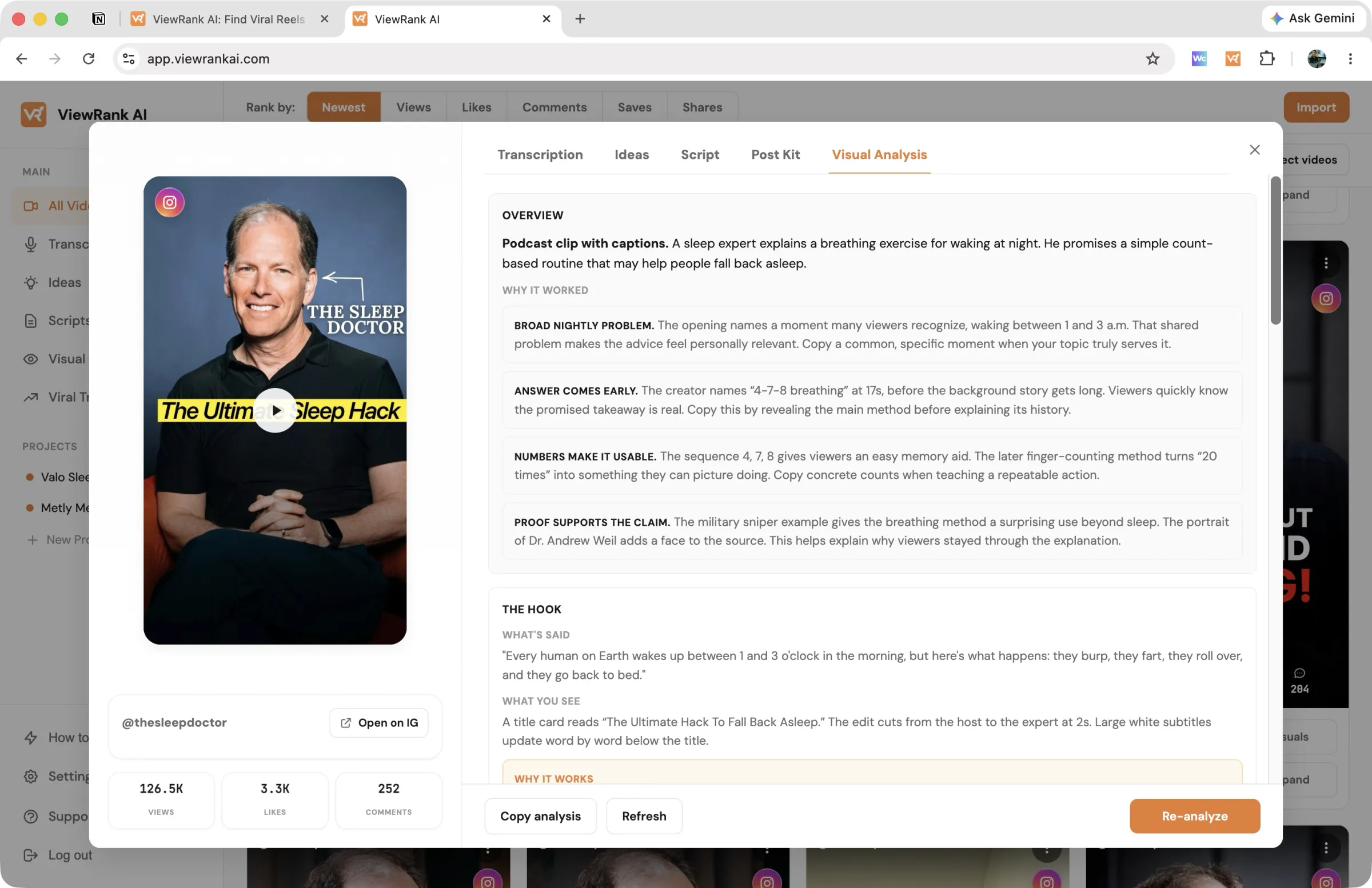
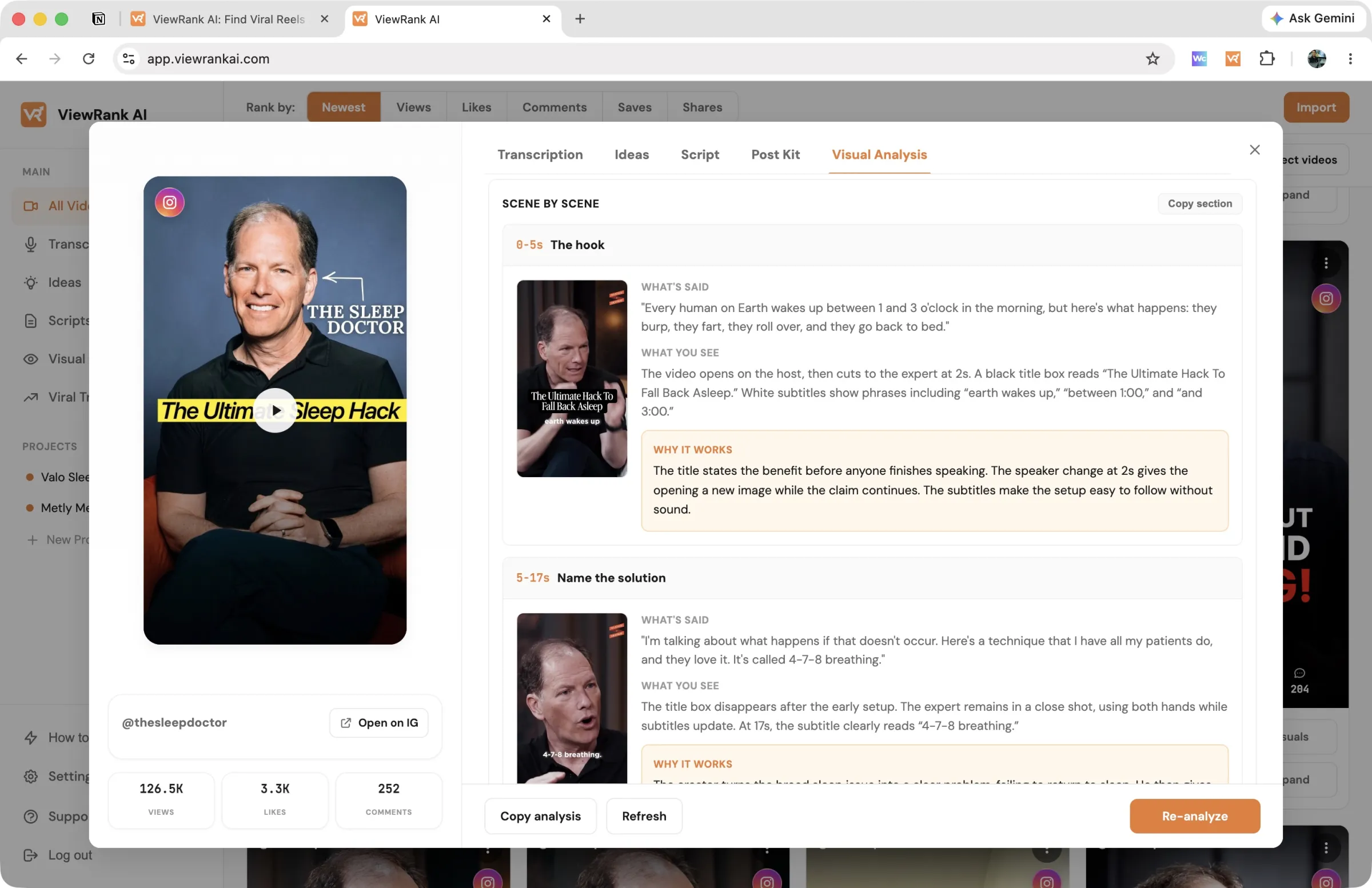
Click Visuals on any video in your library and it starts, or paste a public Instagram, TikTok or YouTube Shorts link into the Visual Analysis panel and it imports and analyses in one go. It reads the transcript for the "what's said" line on every scene, so a video that hasn't been transcribed gets transcribed as part of the job.
A Copy button at the top of the scene walkthrough puts the whole thing, frames included, into a document, which is where the skeleton paragraph gets written.
The part it doesn't do for you is pass 5. Nobody can read another account's retention data, so where you almost stopped watching is still yours to notice. Documentation is on the visual analysis page.
Want to know why those videos worked?
ViewRank AI transcribes winning videos, breaks down their visuals scene by scene, and turns the patterns into fresh ideas and scripts for your own niche. Free for 7 days. Cancel anytime.
Start your free trialFAQ
How do you break down a viral video scene by scene?
Watch it five times, once per layer. First the hook alone, frame by frame. Then map the scene boundaries and name each scene by its job. Then read the transcript as text. Then watch it muted to see what the visuals carry alone. Finally watch it noticing where your own attention nearly broke. Record each pass in a table with columns for timestamp, what's said, what's on screen, and what the moment does.
Can you see the retention graph of someone else's Reel or TikTok?
No. Both platforms show retention data only to the account that posted the video. Anyone publishing a retention curve for a video they don't own is estimating. What you can do is note where your own attention nearly broke and compare that pattern across many videos.
How many scenes does a typical viral short have?
Usually three to six. A scene changes when the shot, framing or location changes, or when the on-screen text moves the video to a new point. Six scenes in 30 seconds is a fast cut rhythm; a single unbroken shot means the script and the delivery are carrying everything.
Why watch a video with the sound off?
To find out whether the visual layer can stand alone. Some people always watch muted, and a video that still makes sense without audio has a structure you can rebuild in a different language and a different voice. If it collapses when muted, the script is the video.
How long should breaking down one video take?
Twenty to thirty minutes done properly by hand, which is the reason most people abandon the habit after a few videos. It's worth doing manually on the first several so you know what you're looking for, then speeding it up.
Is it legal to copy a viral video format?
Recreating a format, a structure or a hook shape is standard practice on both platforms and is not the same as copying a video. Re-uploading someone's footage or reciting their script almost word for word is a different thing, and creators and platforms both treat it differently.