How to Write a Reel Script From a Competitor's Transcript (Without Copying)
A transcript shows you the hook angle, the sentence rhythm and the beat order that made a video work. Here is how to pull the structure out of someone else's words and write your own script on top of it.
Take the competitor's transcript, strip out every word specific to their topic, and what's left is a script structure you can legally and usefully build on. That structure is the hook angle, the order the beats arrive in, the sentence rhythm, and the places the video restates its own promise. None of it belongs to anyone. The words do.
This is the difference between studying a video and copying it, and the line is clearer than people assume. Rewrite someone's script with synonyms and you get a worse version of a video that already exists, competing against an original that has the audience. Extracting the skeleton and filling it with information only you have produces something new that happens to be built on a proven frame.
The method below takes about 25 minutes per script by hand. Everything in the first six sections works with a free transcript and a text editor.
Why start from a transcript instead of the video?
Because watching a video judges the delivery, and reading it judges the writing.
A confident creator with good timing can carry a mediocre script, and if you learn from watching, you'll copy the confidence and wonder why your version fell flat. On the page, the delivery disappears. What's left is the sequence of claims, and the sequence is the part that transfers.
Reading also lets you see things watching hides. How early the specific promise lands. How short the sentences are. How many concrete nouns per line. Where the creator says nothing at all and lets a shot do the work.
Get the transcript as text before you do anything else. Our free Instagram reel transcript generator and TikTok transcript generator return the spoken lines from any public video without an account. If the source is a Short, how to transcribe a YouTube Short for free covers that, and the Reel and TikTok routes are in how to transcribe an Instagram Reel and how to transcribe a TikTok.
Step 1: mark the beats
Read the transcript once and draw a line every time the video moves to a new job. You'll usually get four to seven segments in a 45-second script.
Then label each one by what it does, not what it says. A working vocabulary:
- Hook. The promise or the claim.
- Stakes. Why this matters, or what happens if you get it wrong.
- Turn. The "but actually" that reframes the problem.
- Payoff. The thing that was promised.
- Proof. The evidence, the number, the demonstration.
- Objection. The obvious "yes but" handled before the viewer types it.
- Close. What the viewer does now, or the line that loops back to the hook.
Write the labels down the side of the page. That column, on its own, is now a script outline you could hand to someone who has never seen the original.
Notice what's missing as much as what's there. A video with no Proof beat is asking for trust it hasn't earned, and that usually shows up as views without saves.
Step 2: take the hook apart
The hook is where most of the result lives, so it gets its own analysis.
Write out the first sentence exactly. Then answer:
What kind of hook is it? There aren't many kinds and it's worth being able to name them. A contradiction of common advice. A specific problem named precisely enough that the sufferer can't scroll past. A result stated up front. A question with a withheld answer. A mistake framed as one the viewer is probably making. An admission that costs the creator something.
How specific is the noun? Vague hooks fail. "Your videos aren't working" is nothing. "Your second reel of the week always dies" is a hook, because it describes a pattern somebody has actually noticed in their own account.
What is withheld, and for how long? Count the seconds between the promise and the payoff. Under three seconds and the hook barely mattered. Over fifteen and the video needs something in the gap.
Would it work on screen with no sound? If the hook only lands spoken, everyone watching muted never received it.
Now write six versions of that same hook shape with your topic in it. Six, not one. The first two will be obvious, and the useful one is usually fourth or fifth.
Step 3: measure the rhythm
Count the words in each sentence of the transcript and write the numbers in a row. You'll see something like 7, 5, 11, 4, 9, 6, 14.
That row is the pacing, and it's the most copyable thing in the whole document. Short-form scripts that hold attention tend to run six to twelve words a sentence, well under normal conversational length, with occasional longer lines for contrast. If your own draft comes out at 18, 22, 19, 24, the video will feel slow no matter how good the information is.
Two more counts worth making. How many concrete nouns and numbers appear in the first fifteen words, since specificity front-loads. And how many times the video restates its own promise, because strong scripts re-anchor at least once around the eight to ten second mark.
Step 4: strip the topic out
Rewrite the transcript with every topic-specific word replaced by a blank or a placeholder.
"The mistake most people make with [X] is [Y], and it costs them [Z]. I did this for [time period] before I noticed. Here's what changed when I stopped."
What you're left with is a template. It is not the creator's intellectual property in any meaningful sense, because that shape exists in ten thousand videos, and the version you fill in will not resemble theirs.
This is also the honesty check. If your stripped template still contains a phrase that's distinctly theirs, a joke, an unusual metaphor, a signature line, take it out. That's the part that belongs to them.
Step 5: fill it with something only you have
Here's where most people produce a weaker copy. They fill the template with general knowledge, and general knowledge is what the original already had.
Fill it instead with a specific you own. A number from your own work. A mistake you made and what it cost. A thing a client said. A result with a date on it. The template gives you the shape; the reason anyone watches yours instead of theirs is the specific.
If you can't put a specific into the payoff beat, you've picked the wrong template for your topic. Go back to your outlier list and find a video whose structure suits something you actually know. Structures from unrelated niches often fit better than your competitors' do, which is the outlier transfer method.
Step 6: read the script out loud, then cut a fifth
Read your draft aloud once, at the speed you'd actually record it. Time it.
Anything your mouth stumbles on gets rewritten, because you'll stumble on it on camera too. Anything you can say faster than you wrote it gets shortened to how you said it.
Then cut roughly 20% of the words without removing any beat. Nearly every first draft has them, usually in the second and third sentences, where writers explain something the viewer already accepted. That cut is what moves a script from sounding written to sounding spoken.
What not to take from a competitor's script
Do not take the words. Not rearranged, not with synonyms, not "inspired by" at the sentence level.
Do not take the specific hook line if it's distinctive. A generic shape is fine. A memorable exact phrasing is theirs, and other creators in your niche will recognize it immediately, which is a reputational cost rather than a legal one.
Do not take a personal story. Obvious, and it happens constantly.
Do not take the sound if it's a trend-specific audio, unless you actually want to be in that trend. Sounds carry their own timing, and borrowing one commits you to the pacing that came with it.
Writing the script with ViewRank AI
The manual method above is the one to learn, because it teaches you to see structure, and after ten scripts you'll do it in your head. The bottleneck is that it's 25 minutes per video and a content calendar needs more than two.
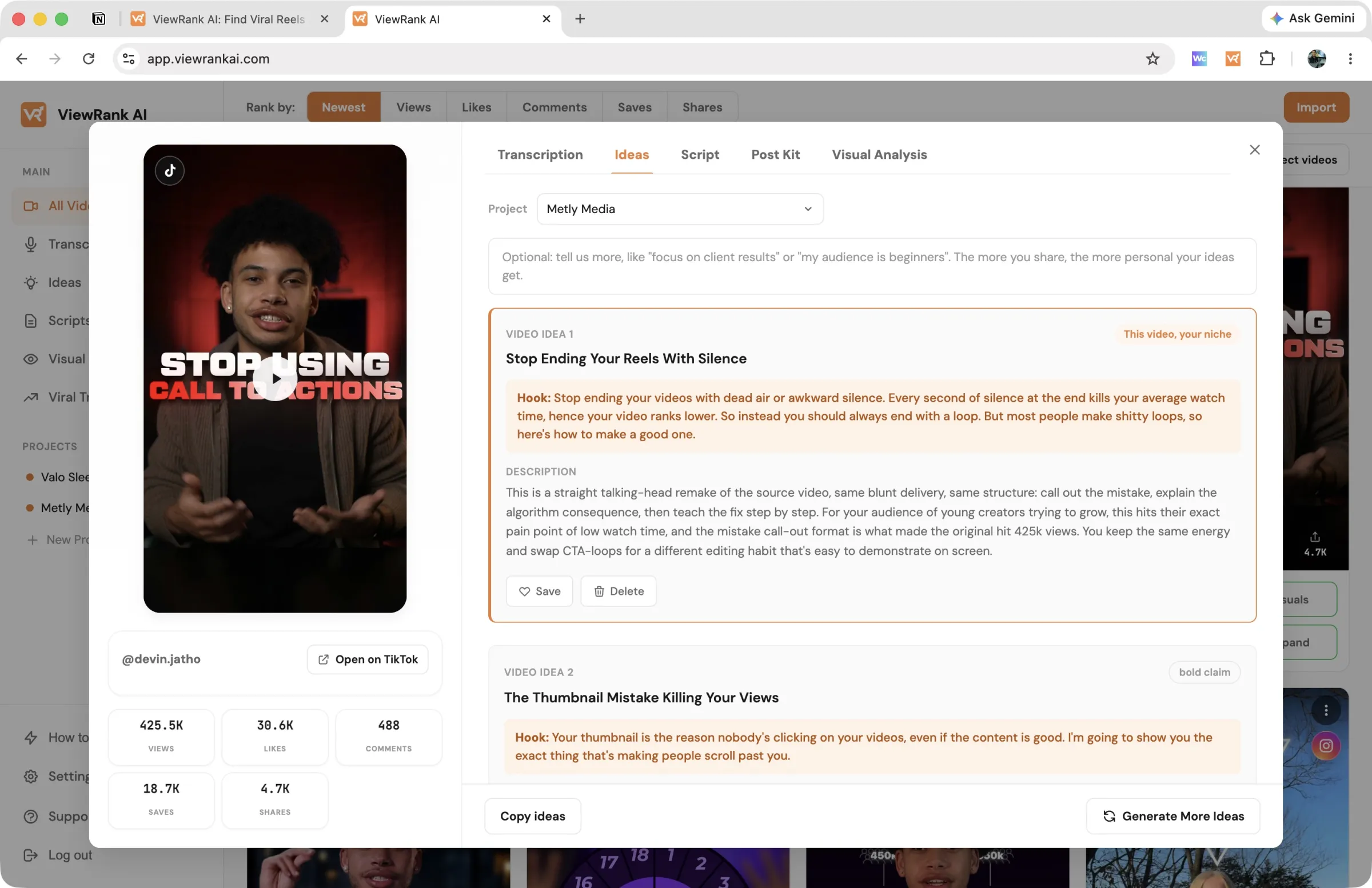
ViewRank AI runs the same sequence. A video goes in, the transcript comes out, then the Ideas step turns it into concepts for your niche, then Scripts writes the draft. ViewRank AI vs Sandcastles shows how this compares with the best-known alternative.
The Ideas step is closer to this method than it sounds. Every run returns four, and the first one is a deliberate remake, the same format and the same beat order with a topic from your world swapped in, which is exactly step 4 and step 5. The other three take the transferable part, the reason the hook worked, and apply it to different topics with different hook mechanisms.
Scripts then follows the reference video's structure, so a video that won with a bold claim in the first second gives you a script that opens the same way with your subject in it. Two things it does that map to the steps above. Every script comes back with two hooks, A and B, written as genuinely different takes rather than one and a weaker copy, which is step 2's "write six versions" collapsed into a choice. And each script shows its word count and estimated spoken length at the top, which is step 6's read-aloud timing before you've recorded anything.
One thing worth setting up first. The project picker carries your niche, your audience, the formats you actually film, and the notes you wrote about how you sound and words you never use. Leave it on None and you get a competent script written for a general viewer, which is the difference between "5 protein snacks" and "5 protein snacks you can grab at a petrol station between site visits." Only the second one exists because the writer knew who was watching.
Then read it aloud and cut the fifth. That part is still yours. Documentation is on the writing scripts page, and the visual breakdown method covers the layer transcripts can't show you.
Want to know why those videos worked?
ViewRank AI transcribes winning videos, breaks down their visuals scene by scene, and turns the patterns into fresh ideas and scripts for your own niche. Free for 7 days. Cancel anytime.
Start your free trialFAQ
How do you write a script from a competitor's video without copying it?
Label each beat of their transcript by its job rather than its content, then rewrite the transcript with every topic-specific word replaced by a placeholder. What remains is a structure, and structures aren't owned. Fill it with a specific you have and they don't: your own number, your own mistake, your own client result.
Is it legal to use another creator's video structure?
Formats, structures and hook shapes are used across thousands of videos and recreating them is normal practice on both platforms. Reciting someone's script close to word for word, or re-uploading their footage, is a different thing. The practical test is whether a viewer who saw both would call yours a new video or a copy.
How long should a Reel script be?
Most short-form scripts that work run 30 to 75 seconds spoken, with sentences of roughly six to twelve words. Count the words in each sentence of a script you admire and you'll usually find the row of numbers is much shorter than normal speech.
What should you look for in a competitor's transcript?
The order the beats arrive in, how early the specific promise lands, the sentence lengths, how many concrete nouns and numbers appear in the first fifteen words, and how many times the video restates its own promise. Also note where the words stop, since silence usually means a visual is carrying that moment.
How do you get the transcript of an Instagram Reel or TikTok?
Paste the video link into a free transcript tool that returns the spoken lines as text. Reading the words on a page rather than hearing them removes the creator's delivery, which is the least transferable part of any video.
Why write several versions of a hook instead of one?
Because the first two are always the obvious ones. Writing six versions of the same hook shape with your topic in it usually produces the usable one somewhere around the fourth or fifth attempt, after the predictable phrasings are out of your system.